
At Daggers Drawn: Meaning, Examples, Usage, Origin, and Quiz
In serious conflict or hostility with someone.
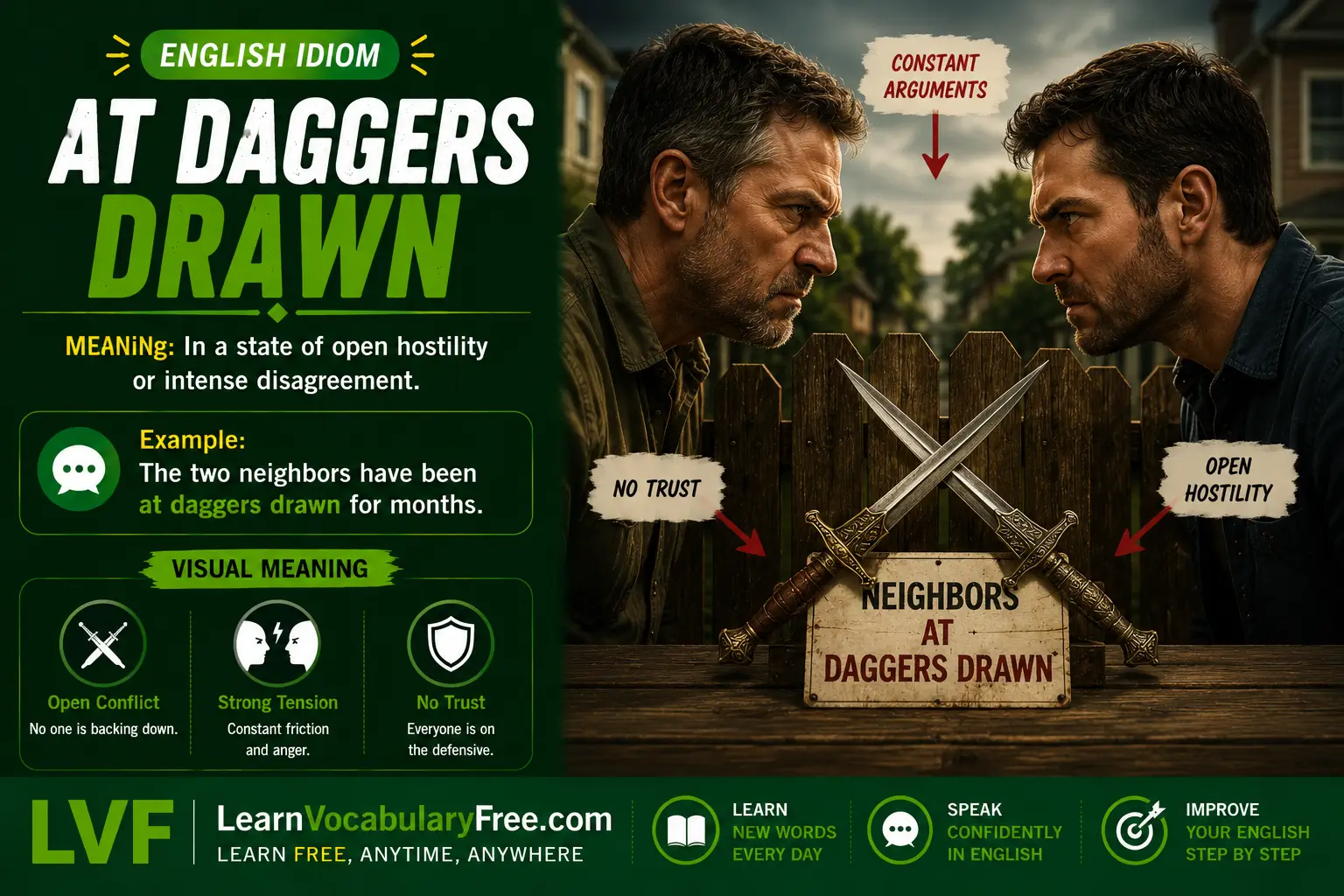
Quick Meaning of “At Daggers Drawn”
At daggers drawn means two people or groups are in serious conflict, strong disagreement, or open hostility.
Example: The two leaders were at daggers drawn over the policy issue.
What Does “At Daggers Drawn” Mean?
The idiom “at daggers drawn” is used when two people, groups, teams, leaders, or organizations are in a serious conflict or hostile disagreement.
In simple terms, if two sides strongly oppose each other and the relationship has become tense or aggressive, you can say they are “at daggers drawn.”
Meaning in Real Usage
In real English usage, “at daggers drawn” often appears in discussions about politics, leadership disputes, business conflicts, legal battles, workplace hostility, family disagreements, and serious rivalry.
Examples of “At Daggers Drawn” in Sentences
The two leaders were at daggers drawn over the policy issue.
The two departments were at daggers drawn after the budget decision.
The rival companies were at daggers drawn after months of legal disputes and public accusations.
Is This Idiom Formal or Informal?
“At daggers drawn” is a strong and advanced idiom. It works well in formal writing, news-style writing, political discussion, business commentary, storytelling, and advanced English communication.
Real-Life Scenario
Two senior managers disagree strongly about company strategy. Their meetings become tense, and each side openly criticizes the other. In this situation, they are at daggers drawn.
How to Use This Idiom Naturally
Use “at daggers drawn” when two sides are not just disagreeing politely, but are in serious conflict or hostility.
It works especially well when describing intense disputes, rivalries, political conflicts, workplace hostility, or deep personal disagreement.
Why Not Just Say “In Conflict”?
Saying two people are “at daggers drawn” is stronger and more dramatic than simply saying “in conflict.” It suggests hostility, tension, and serious opposition between the two sides.
Common Mistake with “At Daggers Drawn”
Do not use this idiom for small disagreements or friendly debates. At daggers drawn should describe serious conflict, strong hostility, or intense opposition.
Similar Idioms to “At Daggers Drawn”
These related idioms and expressions describe serious conflict, hostility, rivalry, disagreement, or strong opposition.
Opposite Expressions
Opposite expressions include: “see eye to eye”, “be on good terms”, “make peace”, and “work together peacefully”, which describe agreement, harmony, or cooperation.
Origin of the Idiom “At Daggers Drawn”
Did you know?
The expression “at daggers drawn” comes from the image of people drawing daggers, meaning they are ready to fight or attack.
Over time, the phrase became a figurative English idiom for serious hostility, sharp disagreement, or intense conflict between people or groups.
Frequently Asked Questions About “At Daggers Drawn”
What does “at daggers drawn” mean?
It means in serious conflict, strong disagreement, or hostility with someone.
Is “at daggers drawn” formal or informal?
It is an advanced idiom that works well in formal, semi-formal, news-style, political, business, and literary contexts.
Can I use “at daggers drawn” for workplace conflict?
Yes. It can describe serious workplace hostility or strong conflict between teams, leaders, or departments.
Quick Practice: Test Your Understanding of “At Daggers Drawn”
Test your understanding of the idiom “at daggers drawn” with these quick questions. These practice questions will help reinforce the meaning, usage, context, and common mistakes of this English idiom.
Question 1 - Meaning: What does “at daggers drawn” mean?
Question 2 - Sentence Usage: Which sentence uses “at daggers drawn” correctly?
Question 3 - Context: When can you use this idiom?
Question 4 - Similar Expression: Which expression has a similar meaning?
Question 5 - Common Mistake: What should you remember about this idiom?
Key Takeaways
- “At daggers drawn” means in serious conflict or hostility with someone.
- It is useful for political, business, legal, workplace, and personal conflicts.
- It is stronger than simply saying “in disagreement.”
- It should be used for serious hostility, not small disagreements.
Final Learning Note
“At daggers drawn” is a powerful advanced idiom for serious conflict and hostility. Learn it when you want to describe two sides that strongly oppose each other and are no longer communicating peacefully.