
In a Pickle: Meaning, Examples, Usage, Origin, and Quiz
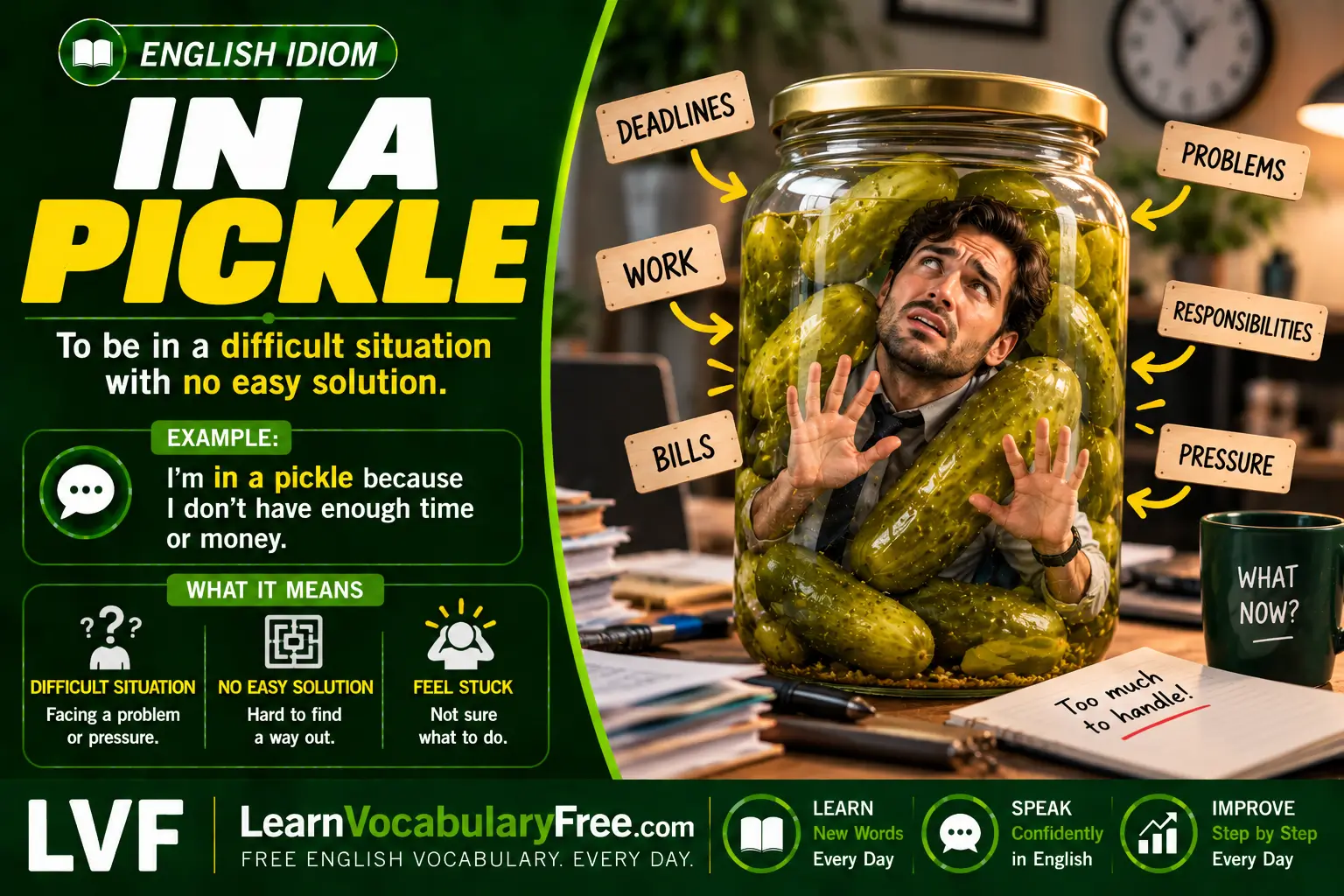
In a difficult or troublesome situation.
Quick Meaning of “In a Pickle”
In a pickle means being in a difficult, awkward, or troublesome situation, especially when you are unsure how to solve a problem.
Example: I’m in a pickle because I lost my wallet.
What Does “In a Pickle” Mean?
The idiom “in a pickle” describes being in a difficult, confusing, or troublesome situation where finding a solution is not easy.
In simple English, if you are in a pickle, you have a problem and may not know what to do next. The expression is often used for unexpected difficulties, embarrassing situations, or problems that require help or quick thinking.
For example, if you lose your wallet while traveling and have no money or identification, you might say, “I'm in a pickle!”
Meaning in Real Usage
In everyday English, “in a pickle” is commonly used when someone faces an awkward or inconvenient problem.
For example, a student may be in a pickle after forgetting an important assignment. A traveler may be in a pickle after missing the last train. Someone may also be in a pickle when two important appointments are scheduled at the same time.
The expression often has a slightly humorous or lighthearted tone, even when the situation is genuinely inconvenient. It is usually more suitable for everyday problems than extremely serious emergencies.
Examples of “In a Pickle” in Sentences
I’m in a pickle because I lost my wallet.
We were in a pickle when our car broke down on the way to the airport.
The event organizers found themselves in a pickle when the main speaker cancelled just hours before the conference was scheduled to begin.
Is This Idiom Formal or Informal?
“In a pickle” is an informal and conversational English idiom. It is useful in daily conversations, spoken English, friendly messages, and informal storytelling.
It can make a description of a problem sound more natural, friendly, or slightly humorous. However, it is generally less suitable for formal academic essays, official reports, or serious professional documents.
In formal writing, you can use alternatives such as “in a difficult situation,” “facing a problem,” or “experiencing difficulties.”
Real-Life Scenario
Emma is shopping at a supermarket. After putting everything into her shopping basket, she reaches the checkout counter and realizes that she has left her wallet at home.
She calls her brother and says, “I'm in a pickle! I forgot my wallet, and I don't have any money to pay for my groceries. Can you help me?”
Emma is in a pickle because she is facing an unexpected and embarrassing problem that she needs to solve.
How to Use This Idiom Naturally
Use “in a pickle” when someone is in trouble, faces an awkward situation, or has a problem that is difficult to solve.
Common sentence patterns include “be in a pickle,” “get into a pickle,” “find yourself in a pickle,” and “leave someone in a pickle.”
For example: “I'm in a pickle because I missed the bus,” “He got into a pickle after forgetting his password,” or “We found ourselves in a pickle when the hotel lost our reservation.”
You can also say “quite a pickle” or “a real pickle” to emphasize how troublesome a situation is.
In a Pickle vs. In a Bind
“In a pickle” means being in a difficult, awkward, or troublesome situation. It often sounds informal, playful, or slightly humorous.
“In a bind” has a closely related meaning but often emphasizes having limited choices or being unable to solve a problem easily.
For example, “I'm in a pickle because I forgot my wallet” sounds conversational and slightly lighthearted. “I'm in a bind because I cannot meet both deadlines” emphasizes a practical difficulty involving limited options.
Both idioms describe difficulties, but their tone and emphasis can differ depending on the context.
Common Mistake with “In a Pickle”
Do not interpret “in a pickle” literally. In idiomatic usage, it does not mean being inside a jar of pickled vegetables or eating pickles.
Remember that the standard expression includes the article “a”. Say “in a pickle,” not “in pickle.”
Also, avoid using this lighthearted expression when discussing extremely serious emergencies or tragedies, where a more direct and sensitive description would be appropriate.
Similar Idioms and Expressions to “In a Pickle”
These related idioms describe difficult situations, trouble, limited choices, or unexpected problems.
Opposite Expressions
Opposite ideas include “in the clear,” “out of trouble,” “in a good position,” and “have everything under control,” which describe situations where someone is safe, comfortable, or no longer facing difficulties.
Origin of the Idiom “In a Pickle”
Did you know?
The expression “in a pickle” has a long history in English. Older uses of the word “pickle” were associated with a condition, situation, or state of affairs, including an unpleasant or troublesome one.
Over time, the expression became established as a figurative way of describing someone caught in an awkward or difficult situation. The idiom is also known from older English literature, including Shakespeare's play The Tempest, although the expression has developed through different historical uses.
Today, “in a pickle” is commonly used in informal English to describe everyday problems, embarrassing situations, and unexpected difficulties.
Frequently Asked Questions About “In a Pickle”
What does “in a pickle” mean?
It means being in a difficult, awkward, or troublesome situation,
especially when you do not know how to solve the problem.
How do you use “in a pickle” in a sentence?
You can say, “I'm in a pickle because I lost my wallet,”
or “We were in a pickle when our car broke down.”
Is “in a pickle” the same as “in a bind”?
Both idioms describe difficult situations. However,
“in a pickle” often sounds more playful or informal,
while “in a bind” can emphasize having limited options.
Quick Practice: Test Your Understanding of “In a Pickle”
Test your understanding of the idiom “in a pickle” with these quick questions. They will help reinforce its meaning, usage, context, and common mistakes.
Question 1 - Meaning: What does “in a pickle” mean?
Question 2 - Sentence Usage: Which sentence uses the idiom correctly?
Question 3 - Context: When is “in a pickle” appropriate?
Question 4 - Similar Expression: Which expression is most similar to “in a pickle”?
Question 5 - Common Mistake: Which statement is correct?
Key Takeaways
- “In a pickle” means being in a difficult, awkward, or troublesome situation.
- It is an informal idiom commonly used in daily conversation and spoken English.
- It often has a lighthearted or slightly humorous tone.
- The correct expression is “in a pickle,” including the article “a.”
- Similar idioms include “in a bind,” “in a tight spot,” and “in hot water.”
Final Learning Note
“In a pickle” is a useful beginner-friendly English idiom for describing everyday difficulties, awkward situations, and unexpected problems. Learning this expression will help you sound more natural in daily conversation, spoken English, and informal writing.