
Battle of Wills: Meaning, Examples, Usage, Origin, and Quiz
A struggle where both sides are determined not to give in.
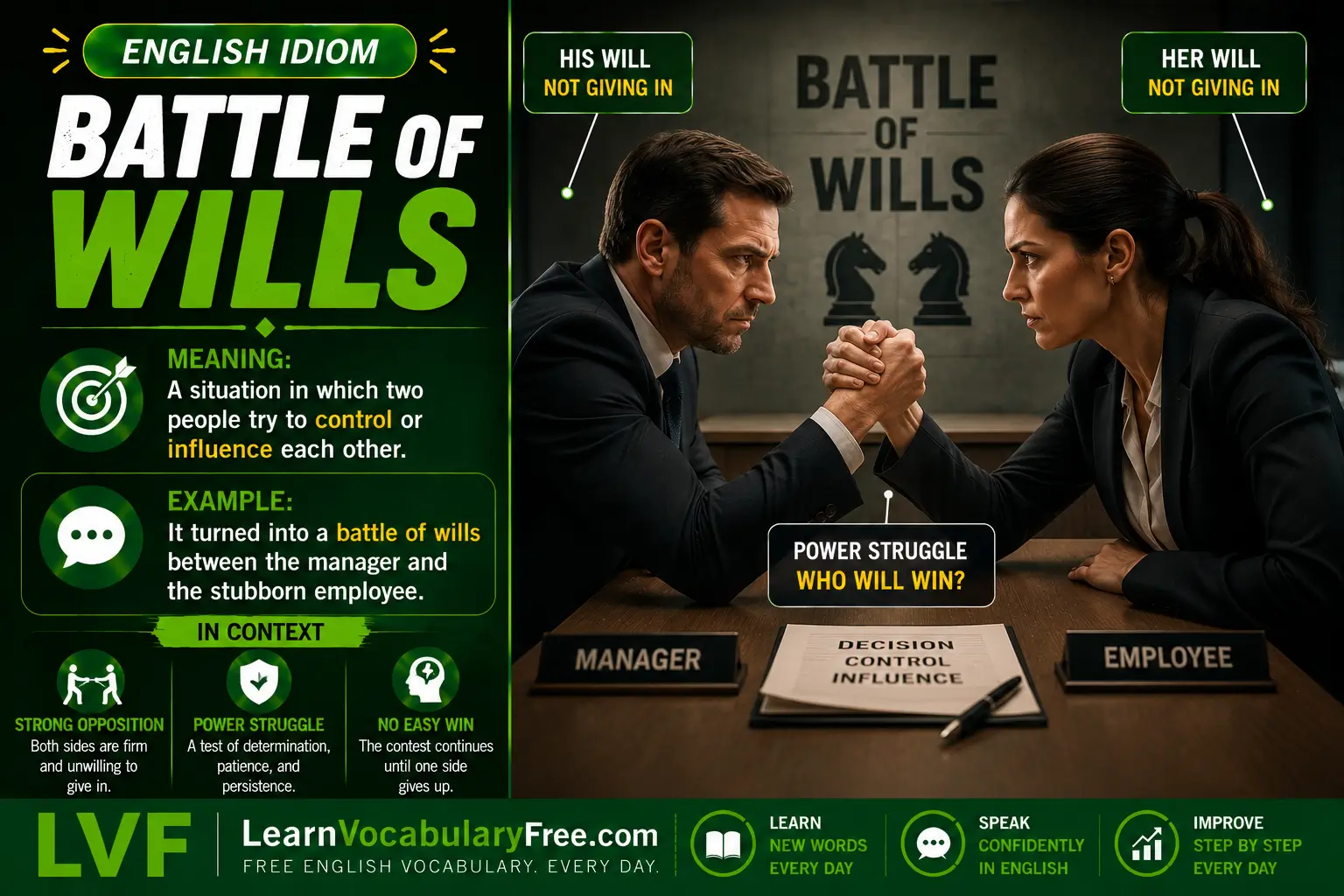
Quick Meaning of “Battle of Wills”
Battle of wills means a conflict where two people or groups are equally determined and neither side wants to give in.
Example: The negotiation became a battle of wills.
What Does “Battle of Wills” Mean?
The idiom “battle of wills” describes a strong conflict, disagreement, or power struggle where both sides are determined to win. Neither side wants to surrender, compromise, or accept the other side’s position easily.
In simple terms, if two people or groups are stubbornly trying to prove their position and refusing to give in, the situation can be called a battle of wills.
Meaning in Real Usage
In real English usage, “battle of wills” is often used in negotiations, politics, leadership, parenting, sports, workplace conflicts, legal disputes, business decisions, and personal relationships.
Examples of “Battle of Wills” in Sentences
The argument became a battle of wills.
The meeting turned into a battle of wills between the manager and the client.
The negotiation became a battle of wills as both companies refused to change their final offer.
Is This Idiom Formal or Informal?
“Battle of wills” is a neutral and advanced idiom. It works well in everyday conversation, business English, news-style writing, professional discussion, political analysis, conflict description, and semi-formal writing.
Real-Life Scenario
Two business partners disagree about the future of their company. One wants to expand quickly, while the other wants to reduce risk and grow slowly. Neither person is willing to change their view, so the discussion becomes a battle of wills.
How to Use This Idiom Naturally
Use “battle of wills” when two people, teams, organizations, or groups are locked in a strong disagreement and both sides are determined not to give in.
It works especially well when describing negotiation, conflict, stubbornness, power struggle, pressure, or determination.
Why Not Just Say “Conflict”?
Saying “battle of wills” is more specific than simply saying “conflict.” It shows that the disagreement is not only about the issue itself, but also about determination, pride, control, and refusal to back down.
Common Mistake with “Battle of Wills”
Do not use “battle of wills” for a small disagreement where one side easily agrees. This idiom is best used when both sides are strongly determined and unwilling to give in.
Similar Idioms to “Battle of Wills”
These related idioms and expressions describe conflict, pressure, power struggle, resistance, and strong disagreement.
Opposite Expressions
Opposite ideas include: “reach a compromise”, “meet halfway”, and “give ground”, which describe cooperation, flexibility, or willingness to adjust one’s position.
Origin of the Idiom “Battle of Wills”
Did you know?
The expression “battle of wills” combines the idea of a battle with the word “will,” which refers to determination, intention, or mental strength.
Over time, the phrase became a common English idiom for describing a conflict where the main struggle is between two strong intentions, not just two opposing ideas.
Frequently Asked Questions About “Battle of Wills”
What does “battle of wills” mean?
It means a struggle where both sides are determined not to give in.
Is “battle of wills” positive or negative?
It is usually neutral or negative because it describes strong resistance, stubbornness, or conflict between determined sides.
Can I use “battle of wills” in business English?
Yes. It is useful in business English when describing negotiations, leadership conflicts, strategy discussions, and workplace disagreements.
Quick Practice: Test Your Understanding of “Battle of Wills”
Test your understanding of the idiom “battle of wills” with these quick questions. These practice questions will help reinforce the meaning, usage, context, and common mistakes of this English idiom.
Question 1 - Meaning: What does “battle of wills” mean?
Question 2 - Sentence Usage: Which sentence uses this idiom correctly?
Question 3 - Context: Where is this idiom commonly used?
Question 4 - Similar Expression: Which expression is most closely related?
Question 5 - Common Usage: What should you remember about this idiom?
Key Takeaways
- “Battle of wills” means a struggle where both sides are determined not to give in.
- It is useful for conflict, negotiation, leadership, workplace, and relationship contexts.
- It suggests strong determination, stubbornness, pressure, and refusal to back down.
- It should not be used for small disagreements that end easily.
Final Learning Note
“Battle of wills” is a powerful advanced English idiom used to describe situations where two sides refuse to give up or compromise. Learn it when discussing negotiations, leadership conflicts, competitive situations, politics, business strategy, parenting, debates, or any situation driven by strong determination and opposing intentions.