
White Elephant: Meaning, Examples, Usage, Origin, and Quiz
A costly or useless possession that is difficult to maintain.
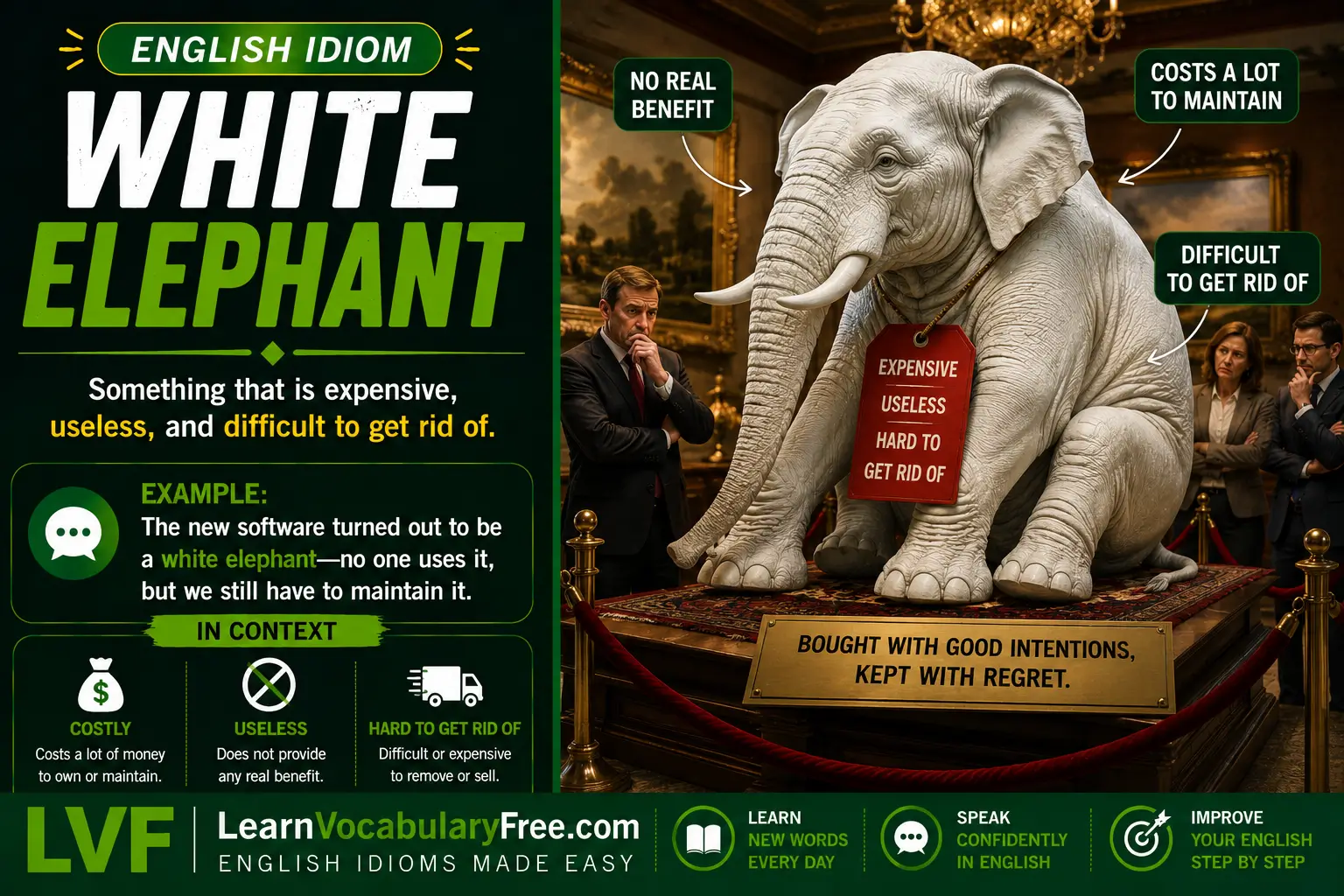
Quick Meaning of “White Elephant”
White elephant means a costly, useless, or unwanted possession that is expensive or difficult to maintain.
Example: The abandoned stadium became a white elephant.
What Does “White Elephant” Mean?
The idiom “white elephant” is used to describe something that costs a lot of money, but gives little practical value or becomes difficult to keep, manage, repair, or maintain.
In simple terms, if something is expensive, unwanted, and more trouble than it is worth, you can call it a “white elephant.”
Meaning in Real Usage
In real English usage, “white elephant” often appears in conversations about abandoned buildings, expensive projects, unused stadiums, failed investments, government spending, business assets, and possessions that become costly burdens.
Examples of “White Elephant” in Sentences
The abandoned stadium became a white elephant.
The old office building is now a white elephant because nobody uses it, but the company still pays for maintenance.
The government’s expensive transport project turned into a white elephant after public demand failed to meet expectations.
Is This Idiom Formal or Informal?
“White elephant” is a neutral and advanced idiom. It works well in business English, finance discussions, news-style writing, economic analysis, workplace communication, and everyday conversation.
Real-Life Scenario
A city builds a large stadium for one event, but after the event ends, very few people use it. The city still spends money on cleaning, security, and maintenance. The stadium becomes a white elephant.
How to Use This Idiom Naturally
Use “white elephant” when something is expensive to own or maintain but does not provide enough value.
It works especially well when discussing wasteful projects, unused assets, costly possessions, failed investments, or impractical purchases.
Why Not Just Say “Useless Thing”?
Saying “white elephant” is stronger and more specific than simply saying “useless thing.” It suggests that the item is not only useless or unwanted, but also costly and difficult to maintain.
Common Mistake with “White Elephant”
Do not use this idiom for something that is merely white or related to an actual elephant. White elephant usually means a costly burden, not a literal animal.
Similar Idioms to “White Elephant”
These related idioms and expressions describe waste, costly burdens, poor investments, or things that give little value compared to their cost.
Opposite Expressions
Opposite expressions include: “good investment”, “valuable asset”, “worth every penny”, and “money well spent”, which describe something useful, valuable, or worth its cost.
Origin of the Idiom “White Elephant”
Did you know?
The expression “white elephant” is commonly linked to rare white elephants that were considered special and sacred in parts of Asia. Owning one could bring honor, but it could also be extremely expensive to care for.
Over time, the phrase became a common English idiom for something costly, difficult to maintain, and not very useful.
Frequently Asked Questions About “White Elephant”
What does “white elephant” mean?
It means a costly or useless possession, project, or asset that is difficult to maintain.
Is “white elephant” used in business English?
Yes. It is commonly used in business, finance, investment, government spending, and project discussions.
Is “white elephant” positive or negative?
It is usually negative because it describes something costly, unwanted, or wasteful.
Quick Practice: Test Your Understanding of “White Elephant”
Test your understanding of the idiom “white elephant” with these quick questions. These practice questions will help reinforce the meaning, usage, context, and common mistakes of this English idiom.
Question 1 - Meaning: What does “white elephant” mean?
Question 2 - Sentence Usage: Which sentence uses “white elephant” correctly?
Question 3 - Context: When can you use this idiom?
Question 4 - Similar Expression: Which expression has a similar meaning?
Question 5 - Common Mistake: What should you remember about this idiom?
Key Takeaways
- “White elephant” means a costly or useless possession that is difficult to maintain.
- It is useful for business, finance, government projects, investments, and wasteful spending.
- It usually has a negative meaning because it describes a burden or waste.
- It should not be understood literally as a real white elephant.
Final Learning Note
“White elephant” is a powerful advanced idiom for waste, cost, and poor value. Learn it when you want to describe something expensive, difficult to maintain, and not useful enough to justify its cost.